
Workshop Navigation
Facilitating the Workshop
Purpose: a facilitator’s role is to guide a group toward shared understanding, decision-making, or problem-solving.
Style of Delivery: facilitation is interactive, encouraging active participation, discussion, and group dynamics.
Content: in facilitation, the content often evolves based on group input and collaborative activities.
Tools and Techniques: facilitators use tools like brainstorming exercises, group activities, whiteboards, or even timeboxing techniques to keep participants engaged.
Role of the Audience: in facilitation, the audience plays an active role, engaging in discussions and shaping outcomes.
Outcome: facilitation is more about collaboration, achieve consensus, or making decisions as a group.
Duration
A few hours to a full day, depending on the number of stakeholders and the complexity of the tasks
Presenting the Process
- Introduction
- What are Strategic Themes?
- The Strategic Themes framework
- Theme components
- Theme criteria
- Theme template
- Application
- Identifying strategic focus areas
- Aligning work to themes
- Benefits
- Clearer strategic direction
- Improved portfolio prioritization
- Example Scenarios
- Use real-world or hypothetical examples
- Implementation Tips
- Tools or frameworks (like SAFe boards)
- Common challenges and how to overcome them
- Q & A or Interactive Exercise
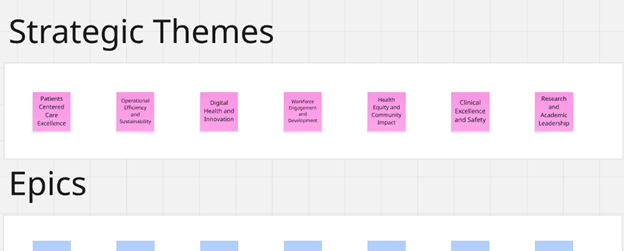
Example Board
Common Anti-Patterns
- Vague or overly broad themes: Strategic Themes should be specific and actionable.
- Too many themes: having more than 3-5 themes dilutes focus and makes it hard to prioritize investments.
- No connection to business objectives: Strategic Themes must tie directly to measurable business goals.
- Poor preparation: without pre-work (market analysis, customer feedback, etc.), discussions can be based on opinions rather than data.
- Dominance by loud voices: if a few individuals dominate the conversation, it can prevent diverse perspectives and lead to biased outcomes.