
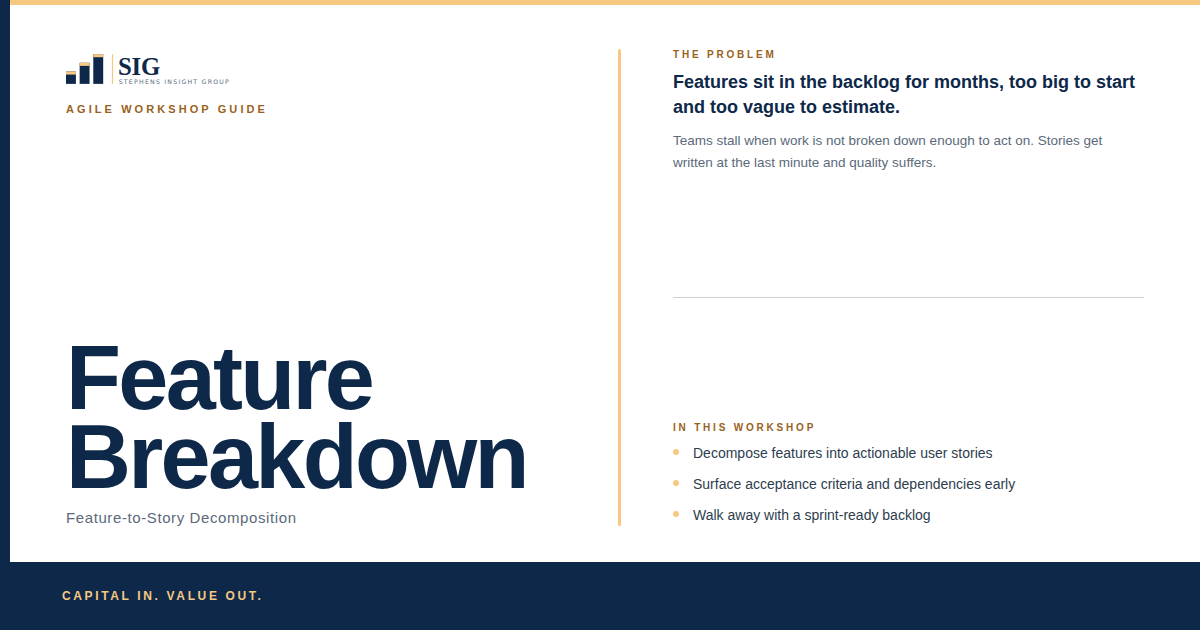

Feature Breakdown
A structured Agile workshop that decomposes high-level features into actionable user stories: aligning teams on scope, dependencies, and value before work begins.
User Stories
→
Acceptance Criteria
→
Prioritized Backlog
01 / Summary
What Is a Feature Breakdown?
The Feature Breakdown Workshop is a structured Agile session designed to help teams decompose high-level features into well-defined, actionable components that align with business priorities and maximize delivery efficiency.
Participants apply structured techniques to refine requirements, establish clear acceptance criteria, surface cross-team dependencies, and ensure the backlog is organized for continuous refinement. The result is a shared understanding of scope and a prioritized list of work that teams can begin delivering incrementally.
Unlike high-level roadmap conversations, a Feature Breakdown Workshop operates at the execution layer: turning strategy into stories that teams can estimate, plan, and ship.
02 / Application
When to Use Feature Breakdown
A Feature Breakdown Workshop is valuable any time a team has a high-level feature that needs to be decomposed before development can begin. Here are the most common scenarios where it delivers immediate impact.
Pre-PI Planning
Teams preparing for a Program Increment need user stories that are well-defined and estimable. A Feature Breakdown Workshop ensures features are ready before PI Planning begins: preventing scope ambiguity during the event.
New Feature Development
When product introduces a net-new capability, the Feature Breakdown Workshop creates a shared understanding of scope, surfaces hidden complexity, and produces a story map that teams can immediately begin refining.
Cross-Team Dependencies
Features that span multiple teams or ARTs require careful decomposition to identify hand-offs, integration points, and sequencing constraints. The workshop surfaces these before planning: not during execution.
Backlog Refinement at Scale
When a backlog has grown too large or too vague for effective sprint planning, a Feature Breakdown session resets the foundation: clarifying scope, removing ambiguity, and re-establishing team confidence in the work ahead.
Prerequisites
Defined Features
A set of features or epics ready for decomposition. Features should have enough business context for the team to meaningfully break them down: but they do not need to be fully specified before the session.
Who You Need
Product Managers or POs who own the features, developers and architects who will deliver them, and key stakeholders who can clarify business intent. Recommended: 5–10 participants per feature set.
Roles and Responsibilities
Stay neutral on scope decisions. Your role is to create the conditions for the team to make good decisions: not to make them for the team.
Focus on the “what” and “why”: not the “how.” Technical decisions belong to the team.
Bring healthy skepticism to scope estimates. The team’s collective instinct about complexity is usually right.
Recommended headcount is 5–10 participants per feature. Larger groups slow the decomposition process and reduce the quality of discussion without meaningfully improving outcomes.
Scheduling and Timing
- Run Feature Breakdown sessions 2–4 weeks before PI Planning to ensure stories are ready for team estimation and capacity planning.
- Schedule separate sessions per feature or feature set: attempting to decompose too many features in one session reduces quality and exhausts participants.
- Allow 2–3 hours per feature set, with buffer time for scope debates and dependency conversations.
- Revisit and refine decomposed stories in regular backlog grooming sessions as technical understanding matures.
03 / Preparation
Preparing for the Workshop
A well-prepared Feature Breakdown session moves fast and produces clean outputs. Invest time before the workshop so participants arrive with context: not questions.
- Confirm the feature list with the Product Manager and ensure each feature has a clear business objective
- Share feature descriptions with participants at least 2 days before the session as pre-read material
- Download and prepare the Story Map Template and the Facilitator’s Presentation
- Schedule the workshop: time, attendees, location, and tool access
-
Send a scheduling communication with agenda, pre-read materials, and expected outcomes
Email Template
Subject: Feature Breakdown Workshop | [Feature Name] | [Date] at [Time]Hi team,
We’re scheduling a Feature Breakdown workshop to decompose [Feature Name] into a prioritized set of user stories with clear acceptance criteria.
Workshop Details
Date: [Date]
Time: [Start–End Time]
Location: [Room / Virtual link]
Duration: [X hours]What to Expect
We’ll break the feature into stories, define acceptance criteria for each, and flag dependencies across teams. You’ll leave with a ready-to-groom story backlog.Before the workshop: review the attached feature description and come ready to discuss scope and edge cases for your area.
Please confirm your attendance by [date]. Your input is critical to getting the breakdown right.
Thanks,
[Name]Calendar Invite Copy
Title: Feature Breakdown Workshop: [Feature Name]Join us to decompose [Feature Name] into user stories with clear acceptance criteria and identified dependencies.
Please come prepared: review the feature description shared in advance, and bring your perspective on scope, edge cases, and dependencies for your area.
Materials
[Miro / Mural / Lucid board link]Facilitator
[Name] - Confirm attendance 1–2 days prior and resolve any scheduling conflicts
- Confirm room setup, screen sharing capability, and collaborative tool access
Room and Technology Setup
Physical Setup
Use a whiteboard or large display for the story map. Arrange seating so all participants can see the canvas and contribute simultaneously. Sticky notes and markers work well for in-person sessions.
Virtual Setup
- Enable screen sharing and real-time editing in your collaboration tool
- Confirm Miro, Mural, or Lucid Charts board access for all participants
- Use breakout rooms for parallel decomposition of multiple features
- Test all technology ahead of time: don’t let setup consume session time
Backlog Tool Access
Ensure participants can access Jira, Azure DevOps, or your backlog management tool during the session. Stories should be created or updated in real time where possible to minimize transcription lag.
Participant Readiness
Stakeholders should arrive with a working understanding of the features being decomposed and the business context behind each one. A brief pre-read and a clear agenda go a long way toward a productive session.
04 / Facilitation
Running the Workshop
Facilitation is about guiding the group toward clarity and shared commitment: not presenting. Your role is to keep the decomposition focused, surface the right voices, and move the team from vague feature descriptions to crisp, estimable stories.
Purpose
Decompose features into well-scoped user stories with clear acceptance criteria and identified dependencies.
Style
Collaborative and iterative. Encourage debate on scope boundaries: healthy disagreement here prevents delivery surprises later.
Outcome
A prioritized, sprint-ready backlog of stories that teams understand, have estimated, and are committed to delivering.
Duration: Most Feature Breakdown workshops run 2–3 hours per feature set. Complex or cross-team features may require follow-up sessions. Plan for discussion: that is where alignment happens.
Workshop Agenda
-
Context Setting
- Review the feature’s business objective and value statement
- Confirm scope boundaries: what is in and what is explicitly out
-
Story Mapping
- Decompose the feature into user activities and tasks
- Draft user stories using the “As a… I want… So that…” format
-
Acceptance Criteria Definition
- Define clear, testable criteria for each story
- Identify edge cases and exception paths
-
Dependency Identification
- Surface cross-team and cross-system dependencies
- Flag sequencing constraints and integration requirements
-
Relative Sizing
- Size stories using story points or t-shirt sizing
- Surface stories that need further decomposition before they can be estimated
-
Prioritization and Backlog Ordering
- Apply WSJF or MoSCoW to order stories by value and urgency
- Confirm the backlog order with the Product Owner before closing the session
Common Anti-Patterns to Avoid
-
Gold-Plating StoriesAdding unnecessary detail or scope to stories during decomposition inflates estimates and delays delivery. Keep stories focused on the minimum needed to deliver value.
-
Skipping Acceptance CriteriaStories without clear acceptance criteria lead to rework, “done” disputes, and quality gaps. Acceptance criteria should be defined before a story enters a sprint: not after.
-
Technical Tasks Masquerading as StoriesUser stories should describe business or user value: not implementation steps. “Refactor the database schema” is a task, not a story. Keep the backlog focused on outcomes.
-
Decomposing Without the Right PeopleDecomposition done without developers produces stories that miss technical complexity. Done without POs, it loses business intent. Both perspectives are essential to a useful backlog.
-
Creating Stories That Are Too LargeStories that cannot be completed within a single sprint create WIP buildup and hide delivery risk. If a story feels too large to estimate confidently, decompose it further.
05 / Follow-Up
After the Workshop
A successful Feature Breakdown session produces a clear, actionable backlog. What happens next determines whether that work gets delivered efficiently: or gets lost in refinement limbo.
Expected Outputs
Share the resulting backlog with the Product Owner, development team, and relevant stakeholders as soon as possible after the session. Context decays quickly: the sooner the team acts on the output, the more value the workshop delivers.
Follow-Up Communication Template
Dear [Team and Stakeholders],
Following our Feature Breakdown session, we have compiled the decomposed story backlog for [Feature Name] along with acceptance criteria and identified dependencies.
Key Outcomes
Prioritized Story Backlog: the ranked list of user stories ready for sprint planning.
Acceptance Criteria: defined conditions of satisfaction for each story.
Dependencies: cross-team or cross-system dependencies identified during the session.
Next Steps
Story Review: owners for each story have been assigned and deadlines confirmed.
Refinement: remaining open questions will be addressed in the next backlog grooming session.
PI Planning Input: stories are ready to be loaded into the program backlog ahead of PI Planning.
Please review and share any feedback or questions before our next refinement session.
Best regards,
[Signature]
Ongoing Next Steps
- Load decomposed stories into your backlog management tool (Jira, Azure DevOps, Rally) and assign ownership
- Review stories with development teams in the next refinement session to validate estimates and surface any remaining unknowns
- Track and resolve identified dependencies before the work enters a sprint
- Monitor story completion against acceptance criteria to validate that the feature is delivered as intended
- Reflect on the decomposition process: identify stories that required scope changes mid-sprint and use those patterns to improve future sessions
- Update the backlog as technical understanding matures and new requirements emerge
06 / References
References and Resources
- Scaled Agile Framework (SAFe): Features and Components
- Mountain Goat Software: User Stories
- ProductPlan: User Story Mapping
Complimentary Workshops
Epics and Capabilities Workshop
Turn portfolio goals into sized, fundable Epics and Capabilities before a single Feature hits the backlog.
Story Pointing Workshop
Give the team a shared, repeatable way to size backlog items before they commit to a sprint.
Read MoreCapacity Planning Workshop
Balance team capacity against planned PI work so every sprint commitment is realistic and achievable.
Read MoreReady to facilitate?
Download templates and tools to run your own Feature Breakdown session.