
AI ReadinessScoring Guide
What each question measures, why it matters, and how to improve your score.
AI Readiness Self-Assessment
AI initiatives rarely fail on the technology. They fail on the conditions around it: data nobody trusts, leaders who have not agreed what they are trying to achieve, processes too undefined to automate, and teams with no room to absorb a new way of working. This assessment scores those conditions. Below is a breakdown of each scored question: what it measures, why it matters, and concrete steps to improve if your organization scored low.
Score Interpretation
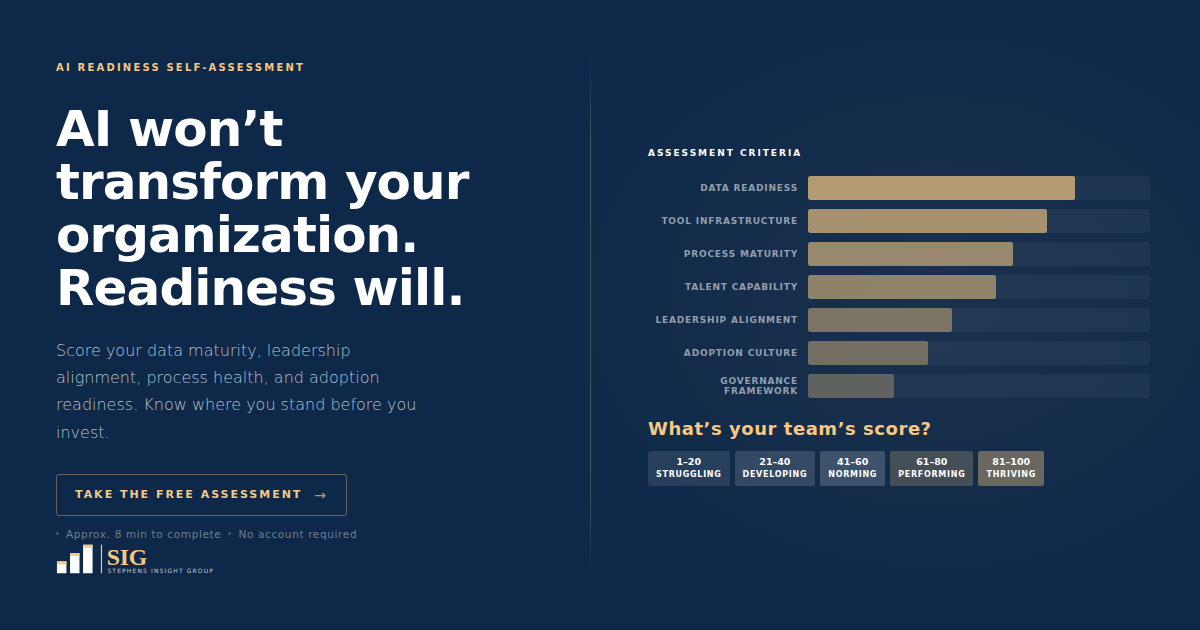
How to read your total maturity score (0 to 100).
1 to 20: Struggling. The foundations are not in place. Data is hard to reach and harder to trust, ownership is undefined, and AI is a topic rather than a program. Investing in tooling now would produce pilots that stall rather than capability that compounds.
21 to 40: Developing. There is interest and some activity, but no shared direction. Efforts are scattered across teams, sponsorship is informal, and nothing is measured, so early wins do not travel and early failures are not learned from.
41 to 60: Norming. The organization has real ingredients: some governance, some sponsorship, some capability. The gap now is connective. Tie the work to strategic goals, put a named owner behind adoption, and create the capacity for teams to actually change how they work.
61 to 80: Performing. You are positioned to scale. Data, leadership, and process are strong enough to support real deployment, and the remaining work is deepening literacy across the workforce and hardening governance so scale does not create risk.
81 to 100: Thriving. AI is part of how the organization operates rather than a set of initiatives. Investment is tied to outcomes, governance is enforced rather than aspirational, and the workforce has the skills and the time to keep adopting. Protect the discipline that produced this.
Data Quality and Accessibility
How would you describe your organization’s data quality and accessibility?
Why it matters: This carries some of the heaviest weight in the assessment because it constrains everything downstream. A model trained or grounded on inconsistent, siloed data produces confident answers nobody can defend, and the first time a leader catches an error, adoption stalls for reasons that have nothing to do with the technology. Accessibility matters as much as quality, because data locked inside a system with no route out becomes a procurement project before it becomes an AI project.
To improve your score: Do not try to fix the whole estate. Pick the two or three data domains that support your first real use cases, profile them for completeness and duplication, and fix those. Establish a single definition for the handful of terms that matter most, such as customer, order, or active user, since disagreement on definitions is usually a larger obstacle than data volume. Give the teams building solutions a documented, permissioned path to that data rather than one off extracts.
Data Ownership and Governance
Do you have defined data ownership and governance processes?
Why it matters: Ownership is what makes data quality durable rather than a cleanup project you repeat every year. When a named owner is accountable for a domain, issues have somewhere to go and decisions about access, retention, and definitions get made. Without it, every AI use case reopens the same questions about who may use what, and legal and security teams become a bottleneck by default because nobody else has the authority to answer.
To improve your score: Name accountable owners for your most important data domains and give them the authority to set definitions and approve access, not just the responsibility to attend meetings. Stand up a lightweight governance forum that meets on a cadence and clears decisions rather than reviewing status. Document classification and handling rules so teams can determine what is permitted without escalating, and keep the process light enough that people follow it.
Leadership Alignment
How aligned is your leadership team on AI goals and priorities?
Why it matters: Misaligned leadership is the most expensive condition on this list, because it does not stop work, it multiplies it. Each function pursues its own interpretation, budget spreads across pilots that do not connect, and the organization ends up with several small proofs and no capability. It also puts delivery teams in an impossible position, defending priorities that were never agreed above them.
To improve your score: Get the leadership team into a single working session and force a small number of explicit choices: what AI is for in your organization over the next year, which two or three outcomes it must move, and what you are deliberately not doing. Write those down and tie budget to them. Revisit quarterly with evidence rather than opinion. Alignment that lives only in a strategy document will not survive the first resourcing conflict.
Executive Sponsorship
Does your organization have executive sponsorship for AI initiatives?
Why it matters: Interest is not sponsorship. A sponsor with authority can move budget, resolve a conflict between functions, and decide that a process will change rather than asking a team to negotiate for it. Informal support feels similar until the first hard tradeoff, at which point the initiative loses to whatever has a named owner and a committed budget. Most stalled AI programs are not underfunded, they are unsponsored.
To improve your score: Name one accountable executive whose objectives include the outcome the AI work is meant to produce, not the delivery of the technology itself. Give them a standing decision forum and a defined budget. Make sure they are visible in the work, because the fastest signal to an organization that something matters is a senior leader asking about it in public on a regular cadence.
Process Documentation
How stable and documented are your core business processes?
Why it matters: You cannot automate or augment a process nobody can describe. Where work varies by team and lives in individual habit, an AI implementation is forced to encode one version of the process and immediately breaks for everyone else. Undocumented processes also make benefit impossible to prove, because there is no baseline to measure the improvement against.
To improve your score: Document only the processes in scope for your first use cases and do it with the people who actually perform the work rather than from a policy manual. Capture the real path, including the exceptions and workarounds, since the exceptions are usually where the effort sits. Standardize the variations that have no good reason to differ before you automate anything. Record the current cycle time and error rate so you have a baseline worth comparing to.
Change Capability
How capable is your organization of adopting new ways of working?
Why it matters: AI adoption is a change program with a technology component, and organizations tend to repeat their history. If previous initiatives stalled after launch, the same pattern will appear here regardless of how good the tool is, because the failure mode is not the software but the absence of reinforcement, incentives, and follow through once attention moves elsewhere.
To improve your score: Be honest about the last two significant changes you attempted and what actually happened, then design around those causes. Fund adoption as explicitly as you fund the build, including training, support, and a period where productivity dips. Use a small group of respected practitioners as early adopters rather than volunteers with the most free time. Measure usage and outcome after launch, and keep a named owner accountable for both well past go live.
Workforce AI Literacy
What is your workforce’s current level of AI literacy?
Why it matters: Literacy determines whether capability spreads or stays trapped in a few enthusiasts. When most people understand what these tools do well and where they fail, they find useful applications in their own work and they catch bad output before it reaches a customer. Where literacy is low, tools get used for the wrong tasks, results get trusted uncritically, or the tools get quietly abandoned. Answering that you have not assessed this is its own finding.
To improve your score: Measure it before you train, so you know whether the gap is skill, access, or permission. Then teach in the context of real work rather than in the abstract: role specific sessions where people bring a task they actually own. Cover judgment as much as technique, including what to verify and what never to paste into an external tool. Give people a place to share what worked, since peer examples move adoption faster than formal curriculum.
Dedicated AI Roles
Do you have dedicated roles or teams responsible for AI adoption?
Why it matters: Adoption that is everybody’s responsibility on top of a full workload is nobody’s. Dedicated roles are what turn scattered experiments into shared capability: they evaluate tools once instead of eleven times, capture patterns that work, support teams past the first frustration, and keep governance connected to practice. Shared responsibility can work at small scale, but it consistently loses to delivery pressure.
To improve your score: Start smaller than a center of excellence. One or two people with an explicit mandate, protected time, and a clear remit will outperform a large virtual team with none. Give them ownership of tool evaluation, enablement, and the internal community of practice. Place them close to the business rather than inside a technology function only, and hold them to adoption and outcome measures rather than to the number of pilots launched.
AI Governance Policy
Does your organization have a documented AI governance policy (e.g., acceptable use, data handling, model risk oversight)?
Why it matters: This is the single heaviest question on the assessment, and for good reason. Without a documented and enforced policy, people still use these tools, they just do it invisibly, which puts confidential data into systems nobody has reviewed and puts decisions into outputs nobody has validated. The absence of a policy also slows the work you want, because every new use case becomes a first principles argument with legal, security, and risk.
To improve your score: Write a policy short enough to be read. Cover acceptable use by data classification, which tools are approved and how a new one gets reviewed, what must never be entered into an external service, where human review is required before an output is acted on, and who owns oversight of models in production. Pair it with a fast approval path, because a policy that only says no drives usage underground. Publish it, train against it, and review it as the tools change.
Strategic Linkage
How clearly does your organization connect AI investments to strategic goals?
Why it matters: Investment that is not connected to a stated goal cannot be defended when budgets tighten, and it usually cannot be evaluated either. Organizations in this position accumulate pilots that were interesting rather than valuable, then struggle to explain what the spend produced. Clear linkage also changes the conversation with delivery teams, because they can prioritize against an outcome rather than a request.
To improve your score: Attach every funded AI effort to a specific business objective and a measure that exists independently of the initiative, such as cycle time, cost to serve, or resolution rate. Set the baseline before you start. Review the portfolio quarterly and stop the efforts that are not moving their measure, since the willingness to stop is what makes the linkage credible. Report outcomes to the executive team in business terms rather than in usage statistics.
Team Capacity
Do your teams have the capacity and bandwidth to adopt AI tools and workflows?
Why it matters: Adoption costs time before it saves time. Teams running at full utilization will attend the training and then return to the way they already know, because learning a new workflow is slower at first and there is no room for slower. This is why capable organizations with good tooling still see flat adoption. The constraint is not willingness, it is that nothing was taken off the plate.
To improve your score: Create the room explicitly rather than assuming people will find it. Reduce committed work for the teams going first, or set aside protected time each week for learning and experimentation, and defend it the way you would defend a delivery commitment. Start where the pain is greatest, since motivation offsets some of the cost. Expect a temporary dip in output and tell leadership to expect it, because an unacknowledged dip is what causes an initiative to be pulled early.
Adoption Momentum
How would you describe your organization’s current AI adoption momentum?
Why it matters: Momentum tells you whether the organization is learning by doing or still deciding. Active pilots with measurable results create internal evidence, which is far more persuasive than any external case study, and they surface the practical obstacles that only appear once real work runs through a tool. Exploring without acting has a cost too, because the readiness you build in analysis decays while the tools keep changing.
To improve your score: Choose one use case with a clear owner, a bounded scope, and a measure agreed in advance, and run it to a decision within a quarter. Publish what happened internally, including what did not work. Convert what worked into a repeatable pattern rather than leaving it as a story. Two finished efforts with evidence will unlock more of the organization than a dozen open experiments.
Primary Adoption Barrier
What is the biggest barrier to AI adoption in your organization?
Why it matters: This question does not add points. It is a routing question, and it matters because it tells you which of your low scores to attack first. Naming skills points you at literacy and dedicated roles. Naming data points you at quality, access, and ownership. Naming leadership points you at alignment and sponsorship. Naming process or organizational readiness points you at documentation, change capability, and capacity.
To improve your score: Treat your answer as the sequence for the next two quarters and check it against the rest of your results, because the barrier leaders name and the barrier the scores reveal are not always the same. Where they disagree, that gap is worth a conversation on its own. Pick the one constraint you will address first, fund it properly, and resist the temptation to work all four at once with a fraction of the attention each.