
SIG AI Toolkit & Free Cheat Sheet
Rovo for Jira:
The Quality Audit Cheat Sheet
Copy and paste prompts to audit backlog health, story quality, acceptance criteria, dependencies, metrics, risks, and compliance. Built for every level, from the board to the ART to the portfolio.
Start Here
Where Rovo lives in Jira
Rovo is Atlassian’s AI built into Jira and Confluence. If your Jira Cloud plan has it turned on, you already have everything on this page. Here is where to find it.
Rovo Chat
Ask questions about your Jira work in plain language and get summaries, tables, and drafts back.
Agents in Jira
Mention an agent in a work item comment, assign work to it, or add it to a workflow status.
Rovo search
Find work items by describing them in plain language instead of writing JQL.
Skills and Studio
Save a repeatable audit as a Rovo skill, or build a custom agent in Rovo Studio.
The three part prompt formula
Scope
Name the board, sprint, project, filter, fix version, PI, or issue key.
Standard
Paste your Definition of Ready, Definition of Done, or story template.
Output
Ask for a table, a score, a top five, or an executive summary.
Put together, it sounds like this
Audit the top 30 items in the [PAYMENTS TEAM] backlog against our definition of ready: [PASTE YOUR DoR]. Return a table with a red, yellow, or green score and a one line fix for each item.
Audit 01
Backlog Quality
Is the backlog ready to plan from, or is it a junk drawer?
Scrum Masters & POs
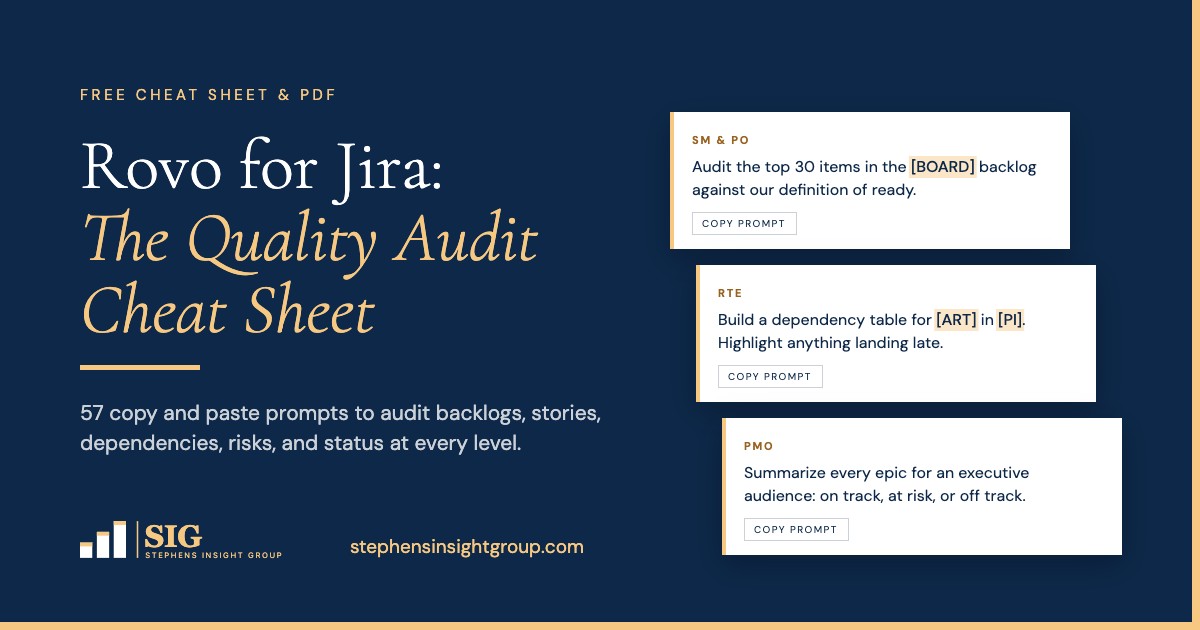
Audit the top 30 ranked items in the [BOARD] backlog. For each one, flag a missing description, missing acceptance criteria, no estimate, no parent epic or feature, or no update in 60 days. Return a table with a red, yellow, or green score and a one line fix.
Scrum Masters & POs
Find duplicate or overlapping work items in the [PROJECT] backlog. Suggest which ones to merge or close and why.
Scrum Masters & POs
List backlog items older than 90 days that have never been in a sprint and have no recent comments. Recommend keep, rework, or close for each.
Scrum Masters & POs
Do we have two sprints of refined work? Compare the estimated, ready items at the top of [BOARD] to our average velocity of [X] points.
RTEs & Program Leaders
Across every team on [ART NAME], score backlog health by team: the percent of the top 20 items that are estimated, have acceptance criteria, and link to a feature.
Portfolio & PMO Leaders
Which epics in [PORTFOLIO PROJECT] have no child features or stories, and which have children but no owner?
Audit 02
User Story Quality
Clear stories make faster teams. Vague ones make rework.
Scrum Masters & POs
Review [ISSUE KEY] against the INVEST criteria. Score each letter from 1 to 5, explain any low score, and rewrite the story so it passes.
Scrum Masters & POs
@Readiness Checker check [ISSUE KEY] against our definition of ready: [PASTE YOUR DoR].
Scrum Masters & POs
List stories in [SPRINT] that read like tasks instead of user value, with no clear user or outcome. Suggest a rewrite for each.
Scrum Masters & POs
Find stories in [SPRINT] estimated above [8] points and propose a split into smaller stories that each still deliver value.
Developers & Testers
Explain [ISSUE KEY] in plain language: what we are building, for whom, what is out of scope, and the open questions I should ask the PO before I start.
Developers & Testers
Is anything in the description of [ISSUE KEY] vague or contradictory? List the questions a tester would ask.
Audit 03
Acceptance Criteria
If you cannot test it, you cannot call it done.
Scrum Masters & POs
List every story in [SPRINT or BOARD] that has no acceptance criteria, or fewer than [2] criteria.
Scrum Masters & POs
Rewrite the acceptance criteria on [ISSUE KEY] in Given, When, Then format. Keep each one testable and add edge cases we missed.
Scrum Masters & POs
Score the acceptance criteria on the stories in [SPRINT] for testability. Is each criterion measurable, unambiguous, and clearly pass or fail?
RTEs & Program Leaders
For features planned in [PI], check that each one has a benefit hypothesis and acceptance criteria. List the ones that do not.
Developers & Testers
From the acceptance criteria on [ISSUE KEY], draft test cases for the happy path, negative paths, and boundary conditions.
Developers & Testers
Compare the acceptance criteria on [ISSUE KEY] to the linked Confluence page [PAGE]. Flag anything in the spec that the criteria do not cover.
Audit 04
Dependencies
Most missed dates start as a dependency nobody tracked.
Scrum Masters & POs
List every work item in [SPRINT] that is blocked by, or depends on, another team. Show the blocking item, its owner, its status, and its planned sprint.
Scrum Masters & POs
Which items in our sprint link to work in another project that has not started yet?
RTEs & Program Leaders
Build a dependency table for [ART] in [PI]: requesting team, providing team, work item, needed by sprint, and current status. Highlight any where the provider lands after the need date.
RTEs & Program Leaders
Which cross team dependencies have no linked work item, or a linked item with no sprint assigned?
Portfolio & PMO Leaders
Which epics in [PORTFOLIO PROJECT] depend on the same shared platform, team, or vendor? Where is a single team becoming a bottleneck?
Developers & Testers
What is linked to [ISSUE KEY]? Summarize anything that could block me or that my change might break.
Audit 05
Performance Metrics
Use Rovo to spot the trend and ask the right question. Confirm hard numbers in Jira reports before you share them.
Scrum Masters & POs
Summarize the last [5] sprints on [BOARD]: committed versus completed, carryover, and scope added after the sprint started. What is the trend?
Scrum Masters & POs
Which work items in [SPRINT] have sat in the same status for more than [3] days? Group them by status and suggest a next step for each.
Scrum Masters & POs
Compare cycle time for stories versus bugs on [BOARD] over the last [90] days and call out the outliers.
RTEs & Program Leaders
For [ART], compare planned versus completed work by team for [PI]. Which teams consistently over commit, and what pattern do you see?
Portfolio & PMO Leaders
Which epics in [PORTFOLIO PROJECT] have grown the most in scope since they started? Compare their child item counts over time.
Developers & Testers
How much of my work last sprint was unplanned? List the items added after the sprint started.
Audit 06
Status Reporting at Every Level
Same Jira data, four different audiences. Tell Rovo who is reading.
Board level
Scrum Masters & POs
Give me a standup summary for [BOARD]: what moved since yesterday, what is stuck, and what is at risk of not finishing this sprint.
Scrum Masters & POs
What changed on [BOARD] since [DATE]? Only meaningful changes: status moves, new blockers, and scope added.
Team level
Scrum Masters & POs
Write a Sprint Review summary for [SPRINT]: the sprint goal, what we finished, what carried over and why, and what we will demo.
Scrum Masters & POs
Draft a weekly team status: overall green, yellow, or red, three highlights, top risks, and asks for leadership. Keep it under 150 words.
Program / ART level
RTEs & Program Leaders
Create an ART status for [ART] in [PI]: progress toward PI objectives by team, features done versus planned, the top 5 risks, dependencies at risk, and decisions needed.
RTEs & Program Leaders
Which features in [PI] are unlikely to finish, based on the remaining stories and the sprints left? Explain your reasoning.
RTEs & Program Leaders
Draft talking points for this week's Coach Sync and PO Sync for [ART].
Portfolio level
Portfolio & PMO Leaders
Summarize every epic in [PORTFOLIO PROJECT] for an executive audience: on track, at risk, or off track, with one sentence on why. No jargon.
Portfolio & PMO Leaders
Which strategic themes or goals have the least active work tied to them right now?
Audit 07
Risk Summary
Pull the risks out of the comments and into the light.
Scrum Masters & POs
Scan the comments and descriptions in [SPRINT] for signals like blocked, waiting, unclear, delayed, or risk. Summarize the real risks and who owns each one.
Scrum Masters & POs
@Jira Delivery Agent what delivery risks do you see in [PROJECT or FIX VERSION]?
RTEs & Program Leaders
Build a ROAM table for [ART] in [PI]: risk, impact, owner, and a proposed status of Resolved, Owned, Accepted, or Mitigated.
RTEs & Program Leaders
Which risks raised at PI Planning are still open with no update in the last two weeks?
Portfolio & PMO Leaders
Summarize the top 10 risks across [PROJECTS] in a one page view for [AUDIENCE]. Rank them by impact on our strategic goals.
Developers & Testers
What is the riskiest change in [SPRINT] from a testing or rollback point of view, and why?
Audit 08
Missing Stories and Gaps
What should be on the board that is not?
Scrum Masters & POs
Read feature [ISSUE KEY] and its acceptance criteria. What stories are missing? Consider error handling, logging, security, accessibility, data migration, documentation, and testing.
Scrum Masters & POs
Compare the requirements on the Confluence page [PAGE] to the stories under [EPIC]. List every requirement with no matching story.
RTEs & Program Leaders
For features in [PI], list any with zero child stories, and any still open even though every child story is done.
RTEs & Program Leaders
@Jira Theme Analyzer group the stories with no parent in [PROJECT] into themes and suggest the epic or feature each one belongs to.
Portfolio & PMO Leaders
Which approved epics in [PORTFOLIO PROJECT] have no features planned for the next PI?
Developers & Testers
What non functional work is missing from [EPIC]? Think performance, security review, monitoring, alerts, and runbooks.
Audit 09
Compliance and Governance
Make the audit trail easy to prove, not painful to rebuild.
Scrum Masters & POs
List the done items in [SPRINT] that do not meet our definition of done: [PASTE YOUR DoD]. Show what is missing on each one.
Scrum Masters & POs
Find items moved to Done in [SPRINT] with no linked pull request, test evidence, or approval comment.
RTEs & Program Leaders
Check that every item in [FIX VERSION] has these required fields completed: [FIELD LIST]. Return only the gaps.
Portfolio & PMO Leaders
For epics labeled [REGULATED LABEL], list any missing approvals, sign offs, or evidence links. Format it as an audit table.
Portfolio & PMO Leaders
Which epics in [PORTFOLIO PROJECT] changed priority or scope after approval, and is there a comment explaining why?
Developers & Testers
Before I close [ISSUE KEY], check it against our definition of done and tell me what is missing.
Quick Scorecard
What good looks like
Run the prompts, then hold the results up against this. If you are seeing more red flags than green, start there.
Agents Worth Knowing
Out of the box Rovo agents for Jira audits
Mention these by name in Rovo Chat or in a work item comment. Availability depends on your plan and admin settings.
Readiness Checker
Checks a work item against your definition of ready and suggests fixes.
Work Item Planner
Breaks epics and large work into smaller, actionable items.
Work Item Organizer
Moves items into sprints, assigns them to epics, and updates them.
Jira Triage Agent
Recommends next steps, field updates, duplicates, and links.
Jira Delivery Agent
Spots delivery risks and turns activity into updates.
Jira Theme Analyzer
Finds themes across work items or groups them into epics.
Progress Tracker
Gives a real time view of in flight projects and priorities.
Bug Report Assistant
Helps write clear bug reports with the details triage needs.
Level Up
Put your audit on autopilot
Save it as a skill
In Rovo Chat, try: "Create a skill that runs our backlog quality audit on [BOARD] using these rules: [YOUR RULES]." Rovo asks clarifying questions and saves it for reuse.
Build a custom agent
In Rovo Studio, give an agent your Definition of Ready, Definition of Done, and story template so every team audits against the same standard.
Put an agent in the workflow
Add an agent to a workflow status, like Ready for Dev, so a readiness check runs automatically when an item arrives there.
Wire it into automation
Use Rovo agents in Jira automation rules, like flagging items that look blocked based on their comments.
Pro Tips
Get better answers from Rovo
Name the scope
Rovo works best with a board, sprint, project, filter, fix version, or issue key.
Paste your standards
Your DoR, DoD, and story template beat Rovo's best guess every time.
Ask for a table
Tables are easier to scan, sort, and paste into Confluence.
Trust, then verify
Spot check numbers against Jira reports before you share them up the chain.
Rovo sees what you see
Results follow your Jira permissions, so leaders may get a wider view than teams.
Share the chat
Shared chats show your team how you got to the answer.
Rovo features, agent names, and availability vary by Atlassian Cloud plan and your admin's settings, and Atlassian updates them often. Agent names and features on this page reflect Atlassian's published documentation as of October 2026. AI can be wrong, so review every output before you act on it or share it.
Sources: Atlassian Support: Out of the box Rovo agents · Atlassian: AI in Jira · Atlassian Blog: Introducing agents in Jira (Feb 2026) · Atlassian Blog: New in Rovo Chat (Sep 2026) · Atlassian Support: Use Rovo to search for work items
Want this running across your ARTs?
SIG helps PMO and program leaders turn AI into a working part of how teams plan, deliver, and report. We can set up your standards, skills, and agents so every team audits the same way.