
SIG Job Family Library
Technical Project & Program Management
(Non-Agile Variant)
Project and program management where technical credibility is the foundation. TPMs work in the same domain they deliver.
About This Family
Delivery expertise rooted in technical knowledge.
This is the Non-Agile variant of the TPM job family, for organizations where delivery follows traditional or hybrid (non-Agile) methods. For the comprehensive TPM family covering both Agile and traditional delivery contexts, see the full TPM family guide.
The Technical Project and Program Management family covers roles that plan, lead, and deliver technology programs while holding genuine technical depth in the same domain being built. This is not a generalist PM role with a technology prefix. TPMs understand the architecture, systems, and technical trade-offs well enough to make independent decisions, manage risk at the implementation level, and earn credibility with engineering teams.
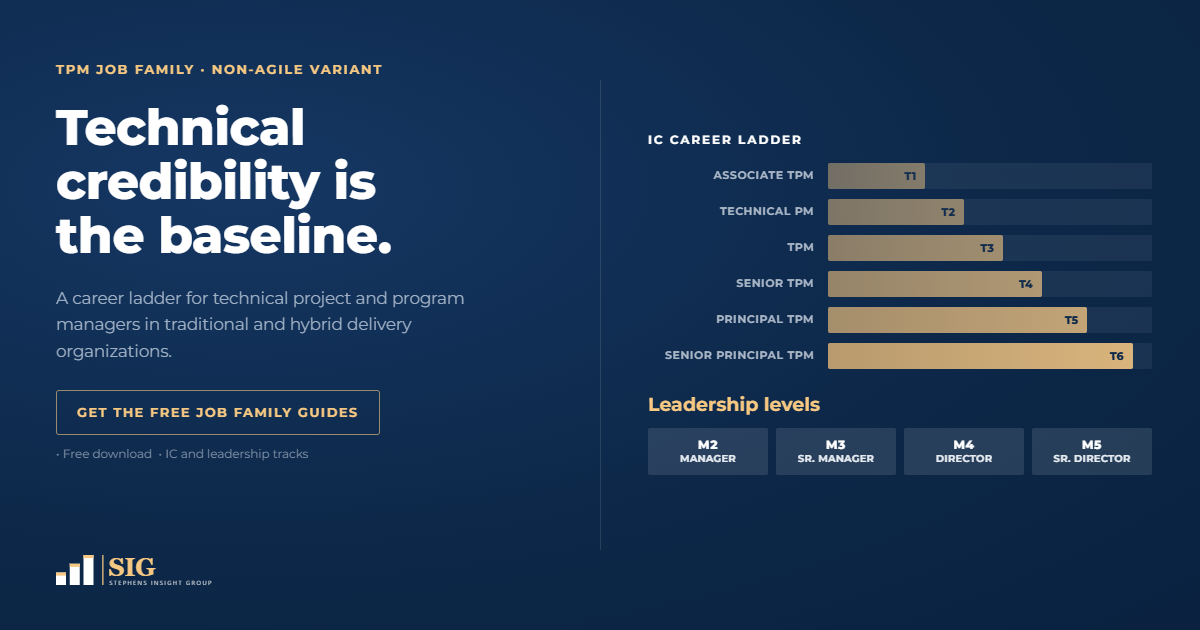
The family spans six Individual Contributor levels (T1 through T6) and four Leadership levels (M2 through M5), scaling from single-project support up to enterprise-wide program portfolio ownership.
Individual Contributor Track
IC Levels at a Glance
Six levels from entry-level project support to senior principal contributor with portfolio scope.
| Level | Title | Typical Scope | Experience |
|---|---|---|---|
| T1 | Associate Technical Project Manager | Single project / workstream | 0-3 years |
| T2 | Technical Project Manager | 1-2 projects independently | 3-5 years |
| T3 | Technical Project & Program Manager | Small-to-medium program (multi-team) | 5-8 years |
| T4 | Senior Technical Project & Program Manager | Complex program (multi-project) | 8-12 years |
| T5 | Principal Technical Project & Program Manager | Large program / multi-program | 12-15 years |
| T6 | Senior Principal Technical Project & Program Manager | Portfolio-level / enterprise strategy | 15+ years |
Leadership Track
Leadership Levels at a Glance
Four levels from first-line management through enterprise senior director.
| Level | Title | Typical Scope | Experience |
|---|---|---|---|
| M2 | Manager, Technology Program Management | Team of 3-8 TPMs; multiple projects | 8-12 yrs delivery + 1-3 yrs mgmt |
| M3 | Senior Manager, Technology Program Management | Multiple programs; manages managers | 12-15 yrs + 3-5 yrs mgmt |
| M4 | Director, Technology Program Management | Division / major portfolio; org-level strategy | 15+ yrs + 5 yrs mgmt |
| M5 | Senior Director, Technology Program Management | Enterprise TPM organization | 18+ yrs + 8 yrs mgmt |
What Sets This Family Apart
Technical credibility is the baseline.
Unlike generalist project management, TPMs hold technical depth in the specific domain they support. They earn trust with engineering teams not through authority, but through understanding. At senior levels, they shape technical strategy, not just execution timelines.
Core Competencies
- Technical domain expertise in delivery area
- Risk identification and technical risk management
- Stakeholder alignment across technical and business lines
- Program and portfolio delivery execution
- Dependency management and cross-team coordination
Common Technical Domains
- Data engineering and analytics platforms
- Infrastructure and cloud architecture
- Software and application development
- Cybersecurity and compliance programs
- Enterprise system implementations
Full Documentation
Get the complete job family guides.
Detailed competency profiles, qualifications, AI maturity expectations, and one-page role cards for every level in this family.
IC Job Family Guide
Full competency profiles for all six IC levels, with qualifications and AI maturity expectations.
Download GuideLeadership Job Family Guide
Full profiles for M2 through M5, including people leadership and delivery competencies.
Download GuideIC Role Cards
One-page role cards for each IC level. Ready to use in hiring and team development conversations.
Download CardsBuilding or refining your
TPM organization?
SIG helps technology organizations build the right delivery capacity for the work ahead. Advisory retainers, embedded engagements, and workshop facilitation.